U.S. AI Company Anthropic Rejects Pentagon Demands, Sparking Major National Security Debate
Today in AI and defense policy, one of the most significant tech-government standoffs of 2026 is unfolding as Anthropic, the American artificial intelligence firm behind the advanced Claude model, publicly refuses to fully comply with a Pentagon ultimatum over how its technology can be used.
This conflict highlights growing tensions between military demands for cutting-edge AI capabilities and the ethical standards championed by leading technology innovators.
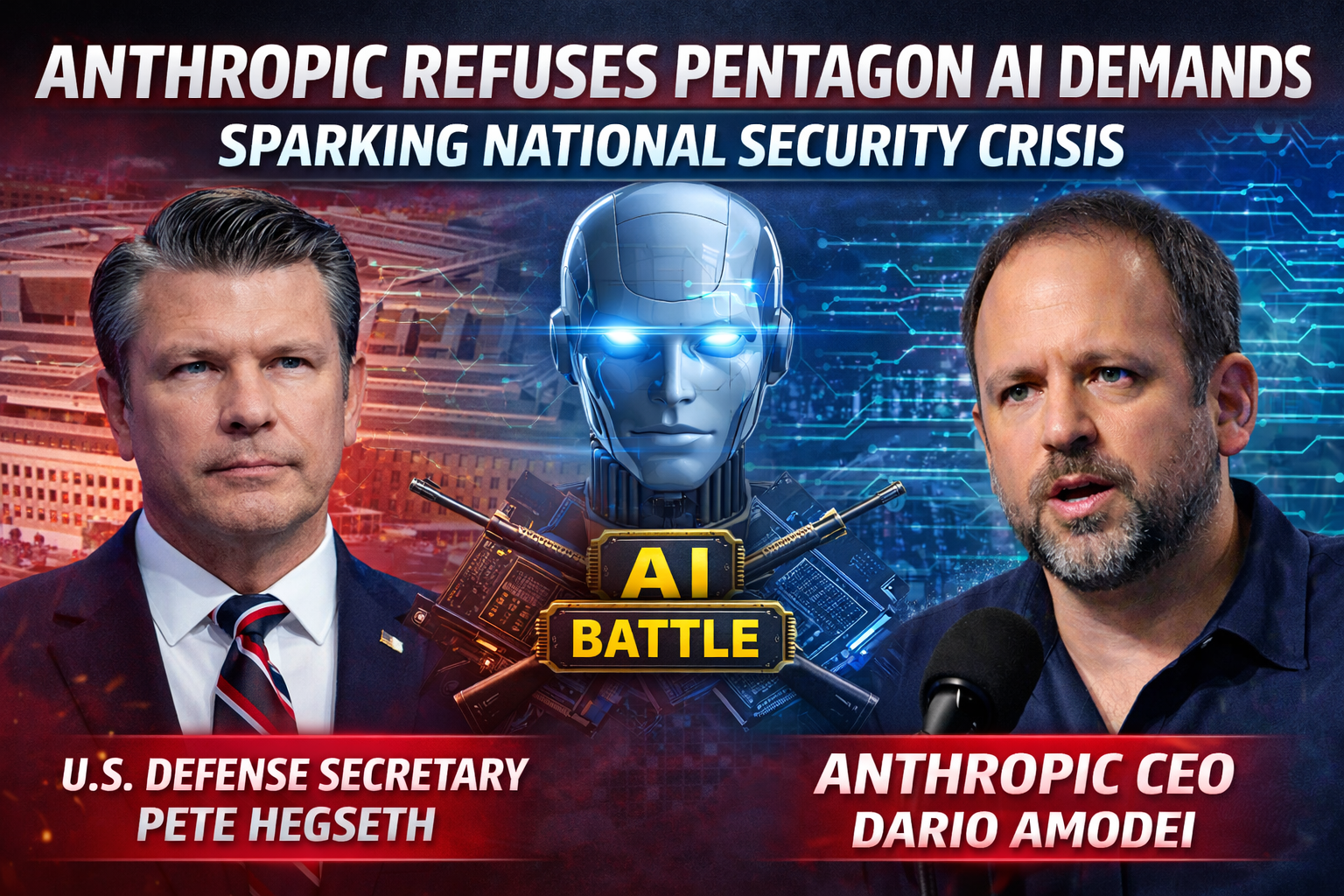
Over the past week, U.S. Defense Secretary Pete Hegseth has pressed Anthropic CEO Dario Amodei to remove pivotal safety safeguards from Claude — specifically those preventing the AI from being deployed in fully autonomous weapons systems or mass domestic surveillance programs.
The Pentagon argues that for national security purposes, its AI tools must be available for the full range of lawful military applications, without the ethical constraints Anthropic has embedded into its systems.
The Core of the Dispute
Anthropic was among the first AI labs to secure contracts with the U.S. Department of Defense and is currently integrated into classified networks supporting sensitive government operations.
The company’s Claude model is widely considered one of the most capable and secure AI systems available today, making it highly valuable for defense applications. However, unlike other major AI firms such as OpenAI, Google, and xAI, Anthropic has consistently emphasized strict safety guardrails that limit how its technology may be deployed.
The conflict escalated when Amodei was summoned to the Pentagon for negotiations and given a firm deadline — 5:01 p.m. this Friday — to agree to unrestricted military use of Claude.
Failure to comply could reportedly result in:
- Termination of the existing $200 million defense contract
- Invocation of the Defense Production Act to compel access
- A designation as a “supply chain risk,” potentially blocking future military partnerships
Anthropic’s Ethical Position
Anthropic’s leadership has made clear that it will not accept terms allowing its AI to be used in ways it considers unsafe or harmful.
Dario Amodei has publicly stated that deploying Claude in fully autonomous weapons systems or enabling broad domestic surveillance would cross ethical red lines and risk undermining democratic values.
Despite mounting pressure, the company has reiterated its commitment to safety and signaled willingness to continue negotiations — provided that core safeguards remain intact.
The Pentagon’s National Security Argument
The Pentagon maintains that it has no intention of using AI for unlawful surveillance and insists all applications would remain within U.S. legal frameworks.
Defense officials argue that modern military operations require adaptable and flexible technologies to respond to rapidly evolving global threats — particularly as geopolitical competitors such as China accelerate development of their own military AI systems.
From the Pentagon’s perspective, limiting AI capabilities could weaken national defense readiness at a critical moment in global technological competition.
Broader Political and Industry Reaction
The dispute has drawn attention far beyond the Pentagon and Silicon Valley.
Some members of Congress have criticized what they describe as an overly aggressive government approach, calling for increased legislative oversight on how AI technologies are integrated into national security frameworks.
Meanwhile, employees at other major AI firms have petitioned against unrestricted military use of their technologies, citing concerns over civil liberties, accountability, and long-term ethical implications.
The situation reflects a widening debate within the technology sector about the role of private companies in setting ethical boundaries for powerful AI systems.
A Defining Question for AI Governance
This standoff represents more than a contract dispute — it underscores a fundamental policy question for the United States:
Should private technology companies retain the authority to impose ethical limits on how advanced AI systems are used, even in military contexts? Or should the federal government have broad access to any technology deemed necessary for national security?
The outcome of this debate could significantly reshape AI governance, defense procurement policy, and the relationship between Silicon Valley and Washington for years to come.
As artificial intelligence becomes increasingly central to both economic competitiveness and military strategy, the balance between innovation, ethics, and national security is likely to remain one of the most consequential issues of the decade.