Anthropic CEO Warns ‘AI Tsunami’ Is Coming – Global AI Alert | AI News 27 Feb 2026
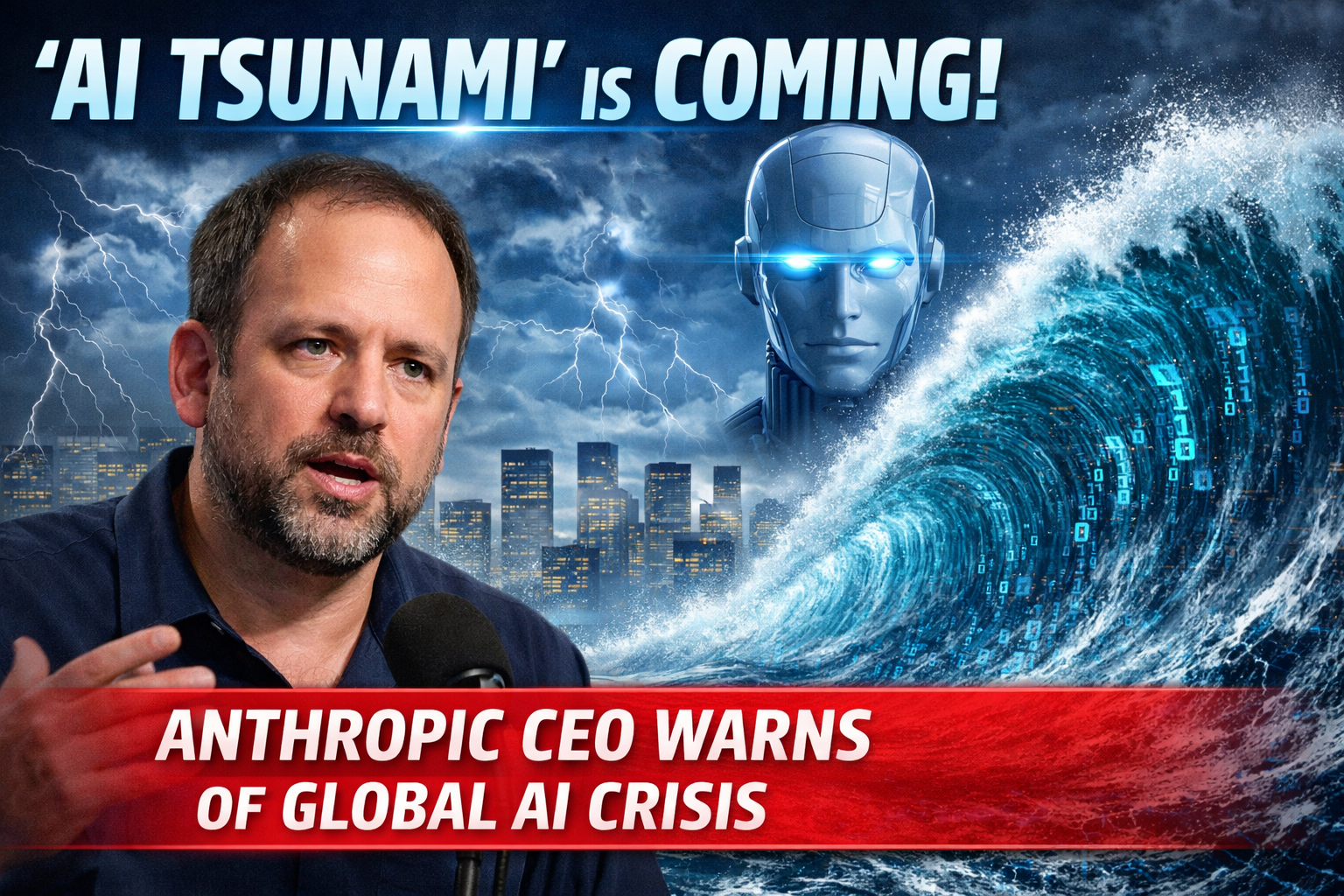
Today’s top artificial intelligence headline focuses on a bold warning from one of the world’s leading AI experts. Dario Amodei, CEO of AI research company Anthropic, has publicly stated that an “AI tsunami” is rapidly approaching — and that society, governments, and businesses are not prepared for it.
His message, shared on a widely discussed podcast, has reignited global conversations about AI’s accelerating pace and its long-term impacts.
Amodei compared artificial intelligence development to a tsunami — a massive wave forming far out at sea that is clearly visible on the horizon, yet not fully acknowledged by those standing on shore. In his view, AI is approaching human-level capabilities much sooner than many expect, and the technological, economic, and cultural effects could be profound.
Why the “AI Tsunami” Warning Matters
Amodei’s statement is not sensationalism. It reflects growing concern within the AI research community about how quickly systems are improving in intelligence, automation, and scalability.
Today’s AI systems are increasingly capable of performing tasks that once required specialized human expertise — including advanced coding, complex data analysis, research synthesis, and high-quality content generation. Many forecasts suggest these capabilities will continue expanding into functions traditionally viewed as inherently human.
According to multiple reports, Amodei emphasized that many institutions — including governments, regulatory bodies, and educational systems — are lagging behind the pace of innovation. This widening gap raises urgent questions about workforce readiness, economic stability, and ethical oversight.
The core challenge is clear: how can society capture AI’s enormous benefits while protecting against unintended economic and social consequences?
Potential Impacts on Jobs and Economies
Amodei highlighted that AI’s disruption will not affect all industries equally.
Routine cognitive tasks — such as basic coding, document processing, data sorting, and repetitive analytical work — are already experiencing significant automation. More complex roles involving leadership, strategy, emotional intelligence, and high-level creative decision-making may evolve more gradually, but they are not immune to AI-driven change.
This uneven automation suggests a future in which traditional job categories may disappear, transform, or merge into entirely new roles.
Labor markets and economies could require large-scale adaptation through:
- Workforce retraining and reskilling initiatives
- Updated educational curricula focused on AI literacy
- New employment models and hybrid human-AI roles
- Expanded social safety nets for displaced workers
Governments worldwide now face mounting pressure to modernize policy frameworks to prepare societies for these rapid shifts.
Regulation, Governance, and Public Awareness
One of the most urgent concerns raised by experts like Amodei is the lack of regulatory frameworks keeping pace with technological growth.
Without strong governance structures, the risks of misuse, ethical failures, data exploitation, and excessive concentration of technological power increase substantially. These concerns extend globally — affecting privacy rights, economic competition, national security, and democratic institutions.
Public awareness remains limited compared to the scale of change underway. While AI researchers and technology leaders understand the accelerating trajectory, many outside these circles still view AI primarily as a productivity tool rather than a transformative force.
Strengthening public understanding will be critical for ensuring informed policymaking, democratic oversight, and responsible innovation.
A Balanced Perspective: Risks and Rewards
Despite the warning, Amodei also acknowledged AI’s immense positive potential.
Advanced AI systems may accelerate breakthroughs in:
- Healthcare research and drug discovery
- Climate modeling and environmental optimization
- Scientific discovery and engineering
- Education and personalized learning systems
- Global logistics and supply chain efficiency
The central issue, according to experts, is not whether AI will reshape society — but how it will be guided.
Some advocate for global AI safety standards, international cooperation, and regulatory treaties. Others emphasize private-sector accountability, transparent model development, and ethical engineering frameworks. Regardless of the approach, the trajectory of AI development in 2026 and beyond will likely influence economic competitiveness, social equity, and governance structures for decades.
Conclusion
Dario Amodei’s forecast of an approaching “AI tsunami” reflects the accelerating speed of artificial intelligence advancement and the urgency for institutions, policymakers, and societies to catch up.
Whether viewed as a warning, a wake-up call, or a strategic opportunity, one reality is increasingly clear: AI is no longer a distant possibility. It is an emerging force reshaping global systems in real time.
The question is no longer whether AI will transform the world — but whether we will be prepared when the wave reaches shore.





Hi, this is a comment.
To get started with moderating, editing, and deleting comments, please visit the Comments screen in the dashboard.
Commenter avatars come from Gravatar.